"ART is a word which summarizes THE QUALITY OF COMMUNICATION. "
L. Ron Hubbard

Tuesday, June 27, 2006

Ekphrastic art

Monet, Haystack at Sunset, Boston Museum
Ekphrastic art -- artists getting turned on by other artists' art forms -- has its history. I can remember doing a "modern dance" to "13 ways to look at a blackbird" when I was a teen. (I recorded it and played it as I danced.) Ambitious I must say.You might even say that Monet's cathedrals are ekphrastic. And what about those haystacks?

Sometimes I just look around at nature and think "isn't THIS wonderful." Or someone is speaking to me and I'm apparently listening intently but enthralled by the way the light hits their nose.

I've started a new blog for miscellaneous comments on life around me in the blogging universe. It's called Gypsymoth. Take a look if you have time. I used a webpage a designer referred me to to to set up a way to aggregate and read new posts to the blogs that I want to follow. Here's the webpage if anyone is interested in Blogs (they're all the rage right now.)

http://www.sitepronews.com/archives/2006/jun/16prt.html

Took HOURs but is great time saver since it loads all blogs at once, showing you only the new posts.

I close with a quote from the essay "Art" by L. Ron Hubbard:

ART is a word which summarizes THE QUALITY OF COMMUNICATION.

Friday, June 16, 2006

Recent paintings at Great Falls

"Plein Air" painting is defined in dictionary.com as "Of or being a style of painting produced out of doors in natural light."

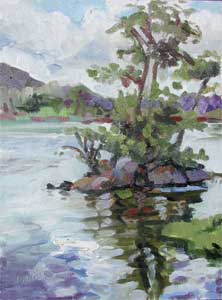
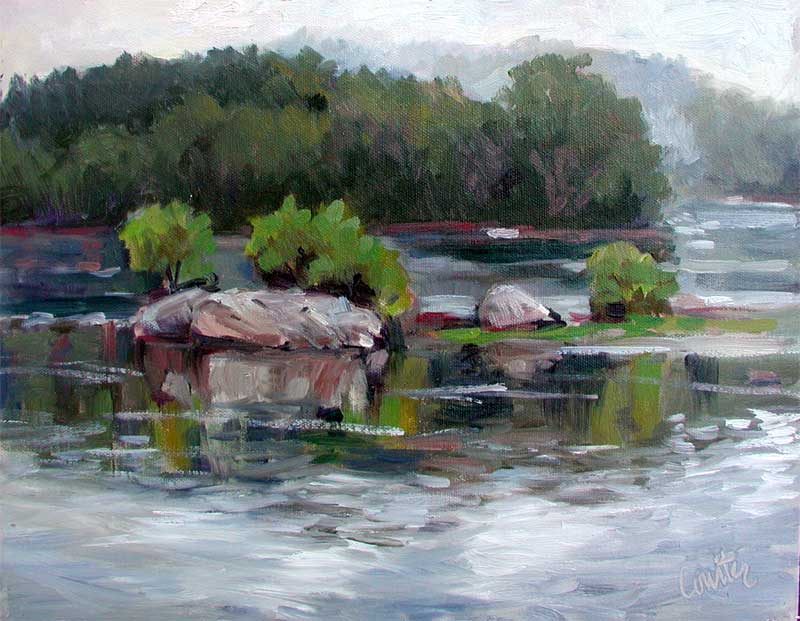
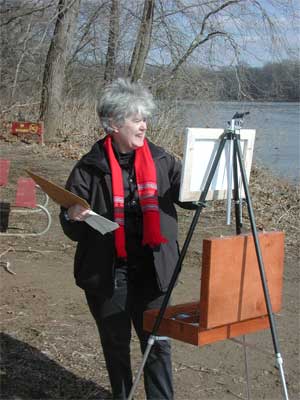
I've been doing a lot of plein air painting since I retired. It was hard to get the daytime hours to do while I was full time employed. I'm thoroughly enjoying getting out into the light again. Here are two very recent examples of plein air, painterly Pam paintings, both fairly small, both done at Great Falls VA.


Painterly vs Linear

Those who know me know I’m primarily a studio artist, not an art historian, so I’m weak on names and styles. Friend and fellow artist Jack Warden recommended I read Heinrich Wolfflin’s Principles of Art History. Although I’ve started it, I can tell it starts at a level of art history knowledge that is above my gradient. However, I came upon one statement that got my interest.

“Distinguishing between “linear” (the development of line as the path of vision and guide of the eye –draftsmanlike painting) and “painterly” (the gradual depreciation of line or massing of values while losing the edges of objects) as two approaches to the painting process, Wolfflin says “In the former case stress is laid on the limits of things; in the other the work tends to look limitless. Seeing by volumes and outlines isolates objects: for the painterly eye, they merge. In the one case interest lies more in the perception of individual material objects as solid, tangible bodies; in the other, in the apprehension of the world as a shifting semblance.”

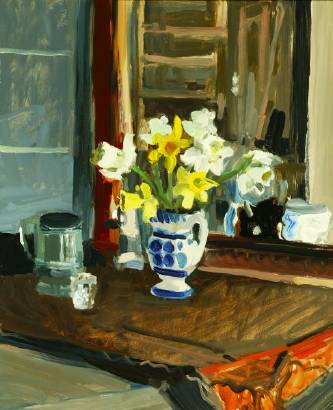
Ben Summerford, Daffodils in blue and white vaseWarden says that Wolfflin was the one who developed the concept of “painterly”. This interests me. I got into a little bit (not a lot) of trouble the other day because I complimented a student for having a very “painterly” style and she asked me what that meant. After stumbling through an explanation, I realized that I had originally gotten the word from my old mentor, Ben Summerford, who used it in an approving way about my work. I’d always assumed that it meant using the paint in such a way that it was important AS paint, not just as an apparency or representation of a form. I’ve included one of Ben Summerford’s paintings here so you can get an idea of his work. He was for many years an art prof at American U. I took classes there summers while I was still in high school.


Wikipedia.org says the following:

An oil painting is "painterly" when there are visible brush strokes, and/or a rough impasto surface. This appearance might occur in oils, acrylics, watercolors, gouache, or any medium where a brush is used. Painterly characterizes the work of Pierre Bonnard, Francis Bacon (painter), Gauguin, Vincent Van Gogh, Rembrandt or Renoir. In watercolor it might be represented by John Singer Sargent. Linear characterizes the work of Vermeer or Ingres. The Impressionists and the Abstract Expressionists tended strongly to be "painterly;" movements such as Pop Art or photo-realism emphasize flatness; Roy Liechtenstein attempted to make a comment on Abstract Expressionist painterliness when he created images of brush strokes, rendered with comic book style inks and colors, complete with Benday dots and other attempts at imitating commercial reproduction processes on the flat picture plane. What Rembrandt is to light, Delacroix is to color. Colorists tend to substitute relations of tonality for relations of value and render the form and shadow and light and time through pure relations of colour.

"Painterly" art makes strong coloristic use of the many visual effects produced by paint on canvas such as chromatic progression, warm and cool tones, complementary and contrasting colors, broken tones, broad brushstrokes, impressionism, impasto and also of the artist's experience in painting. Jackson Pollack's "action paintings" are more "painterly" than Frank Stella's super-graphics.

My painting certainly falls within the “painterly” rather than “linear” category. However, after researching the on-line dictionaries, I can see why I was confused about the word. This just points out the importance of using a dictionary when studying something. In Scientology, after finding that he had difficulty with students confused about or misinterpreting the subject, L. Ron Hubbard spent time researching and codifying study technology and the barriers to study. Now, with the help of the Internet and electronic dictionaries, it’s easier than ever to study, if you know how. And the future of this planet depends on the ability to learn.

Monday, June 05, 2006

Early Morning Rain at River Bend Park


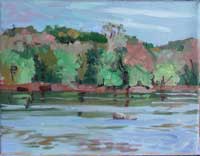
I participated in a "Plein Air" painting "contest" Saturday (June 3, 2006) which was quite fun. Up at 4 am to go to the River Bend Park, painted til 9 am (with a pause for rain shower) and framed and hung the painting for a "wet canvas auction" with 28 other artists. Sold the painting.

By the way, I saw "Breakup" last night and (contrary to some negative reviews on Yahoo) I found it very well done, comic and insightful, all about our "Reactive Mind" and how it messes up relationships, but with hope at the end (no fairytale endings, either.) Recommended.

Shown above is a picture of the painting I sold called Early Morning after Rain, River Bend Park.

Early Morning after Rain River Bend

Thursday, April 27, 2006

Enough words — here's some recent pictures

I thought you might like to see some of the pictures I've been painting on site at the River Bend Park in Great Falls Virginia.

This first one is called River Bend Park, October 2005.

River Bend Park October 2005

The next is titled Rock Formation, River Bend Park, March, 2006.


The next is called Early Spring, River Bend Park 2006 and was painted in March, about the same time as Rock Formation.


Early Spring, River Bend Park 2006


The final one is titled River Bend Park Mid-April 2006 and you can see the early greening of the trees on the MD side of the Potomac.


River Bend Park Mid-April 2006


All of these are quite small, 3 being 8 inches by 10 inches and one 9 by 12.

Friday, April 21, 2006

Reply to a student

A student in my workshop at the Reston Community Center recently emailed me with some thoughts about her art.

"I am really enjoying the painting class. Every night after the class I have a hard time going to sleep because I keep thinking about my painting and how I can improve. I'm really discouraged with this one but I feel that it was my choice in what to paint that has gotten me down. I should have chosen something I am more passionate about. I don't really care about painting flowers. I'd rather paint people but I was too afraid to try. :) ... What a fun class! I wish it was endless......otherwise I prioritize other things and don't get a chance to paint. :) "

Here's my inspirational reply: TA-DA!

I'm so glad you're enjoying the class. I'd suggest that, to keep yourself going, you find other ways to ensure that you keep painting. I know how other pressing things can prevent you from doing art because "it isn't important." So you have to invent ways to protect your art time. For instance, if you can't find a class, find someone that you like to paint with and set up painting sessions and get them to agree that they also won't let anything stop them. For instance, I go out plein air painting regularly with another artist. I know local artists who have a regular "date" on Fridays to have an "art day". Join art organizations like the League of Reston Artists. You'll meet other people interested in painting and can develop art buddies. There's also classes taught by the Loudoun Academy of the Arts and NOVA campus (I think) and I think the Fairfax Schools have programs.

Oh, and don't get discouraged because it isn't all falling together easily. We live in a wonderful age where you can get lots of instruction through books and magazines and tapes. You might want to subscribe to The Artists Magazine -- which has interesting articles about techniques -- and check out the art "how to" books at B&N or the Library.

And on the subject of Competence, please go to the following link and download the e-book "The Way to Happiness" and read especially Chapter 17: Competence. Use it as your guide.

http://thewaytohappiness.org/

Thursday, February 16, 2006

Photos lie

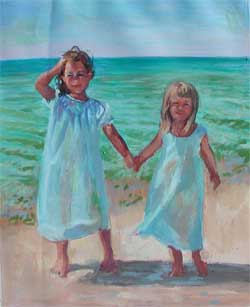
I started this painting in acrylic from a photocopy of a photo and am in the process of overworking the acrylic with oilI have said before to small and large groups who would listen, and I say again: "Photos lie." This is not meant to disparage photography, which can operate very well as an art form in the hands of a capable and experienced photographer. But for the "great unwashed" (including myself) who have gotten our hands on a camera and use it to record impressions of the world around us, it's important to know its limitations.

The picture inserted here of two small children on a beach is something I've worked on entirely from a photocopy of a photo. I started the painting on an unstretched canvas in acrylic and I'm now working over the initial acrylic in oil to enhance the small subtle details.

I recently received a publication put out by Golden Acrylic Colors which contains some substantiating information. I quote below.

"Acrylic paints can be used to create colorful and detailed surfaces on which to add a digital print. This method works around the color-gamut limitations inherent in digital printing, which ultimately still relies on a four-color CMYK process. For example, even newer 6 color systems like Epson’s Ultrachrome™ inks, create expanded ink sets by merely adding transparent versions of Cyan, Magenta, and different Blacks to the base selection. Acrylics, on the other hand, have access to hundreds of individual pigments that can be further modified with Gels and Mediums to generate any degree of translucency you might desire. This provides you with a tremendous amount of control and leaves a significant range of colors, including the special effects of GOLDEN Iridescent and Interference paints, beyond the reach of printing inks alone. The same is true with texture, where you can use acrylic Gels, Mediums and Pastes to produce a wide variety of surfaces that impart a tactile presence not easily achieved by other means."

Many of my current students are using acrylics, and for them I recommend looking the above publication on-line fully. It covers some of the capabilities of Acrylics.

But more generally, and on the theme of "photography lies" I would like to point out that the "gamut" or range of color used in photographs is limited by the inks used to produce them. Those inks are limited by the printing process. Many of you now own inkjet printers and you know that if you want to print out a color print, you have to have four colors (or a maximum of 6 in the newer printers): cyan, magenta, yellow and black. Any color in the scene you are capturing by camera will be normalized to fit some mixture of the three colors and black that your printer contains.

Any artist knows, however, that, unless you choose to paint with a limited palette, you have a much larger variety of colors available. And, in your original paintings (whether it is in acrylic, oil, watercolor, pastel) you have the ability to use this wide range of colors to either duplicate the "reality" that you see in nature or create your own vision.
In addition, acrylics have a wide range of auxillary capabilities: (iridescents, interference colors, textures and pastes) that the photographic or printing field is currently totally unable to capture. (You can see more about this in the above-referenced publication or get on a mailing list to receive the Just Paint newsletter by going to Golden Acrylics homepage and filling out the e-form located in "What's New.")

As a last note, however, although it is frequently practical to work from photos when learning or practicing the art of painting, keep in mind that the information contained in a photo is severely limited. Therefore, my advice is: (1) when possible, whether painting a scene, a still life or a portrait, paint from the thing itself; (2) when working from photos, take your own reference photos and remember that even they lie and; (3) keep in mind that the "reality" of your art is yours to create.

Thursday, February 02, 2006

Stretching a canvas

A student asked me the other day how to stretch a canvas. Many people buy pre-stretched canvases these days since they are readily available. However, if you are doing a number of "exercises" it is less expensive to work on a piece of unstretched canvas mounted on a drawing board or other support with masking tape. (I've even known some artists, who like to work very large, to mount a canvas directly to the (wallboard) wall of their studio with plastic under the canvas, using staples. Then, when finished, they stretch the canvas.

If you are working on unstretched canvas, and you want to be able to stretch it when finished if it comes out good, leave at least 2 inches all around the finished face of the canvas. The easy way to do this is to take a stretched canvas (or a pair of stretchers) and mark the profile of the artwork on the piece of canvas you will be using.

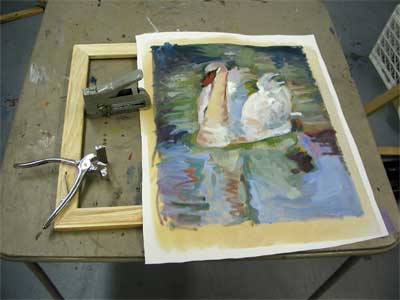
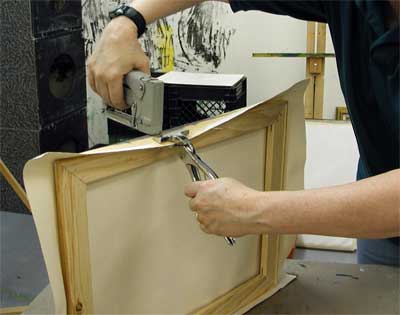
When you have an image that you want to stretch, you will need a heavy duty stapler, a pair of canvas pliers (not absolutely necessary for a small canvas if you have strong fingers but it does make things easier) and a pair of stretchers. Make sure that the stretchers are absolutely square, using a T-square or just putting the assembled pieces into a frame to ensure that they are all at right angles. You can put a couple of staples through each corner to ensure that they stay true. Nothing is more discouraging than to complete your stretching project only to discover that it's not a regular rectangle but some sort of wierd parallelogram.


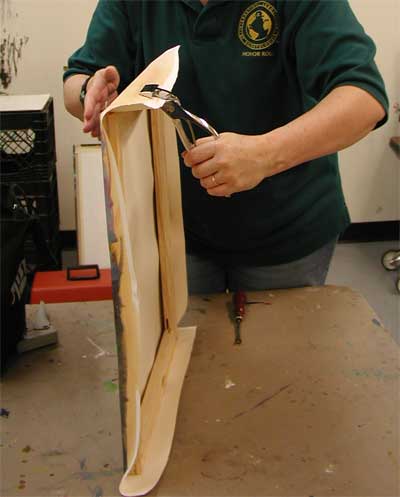
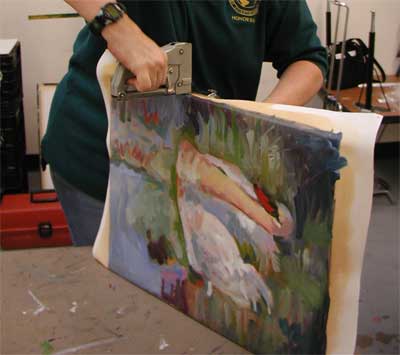
Start the process of stretching by positioning the image on the stretchers and then putting a staple in the middle point of each side (as shown). Note: the traditional method was to use tacks. Staples have replaced them since they are easier. If you choose to use tacks, use the copper tacks. They don't rust.

Don't pull the canvas "too" tight. You don't want to break the paint film by straining it. Just make sure that it's taut in the middle.


Once the 4 sides have one tack and you have ascertained that the image is not askew, begin to move out from the middle on all sides in turn, putting a tack on each side of the middle tack on first one side, then the other, then the two opposing sides. There's no particular science to this. Just make sure, as you go along, that you are keeping the canvas taut in the middle.


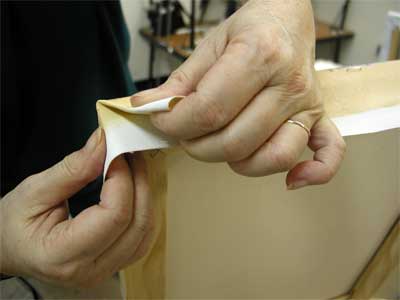
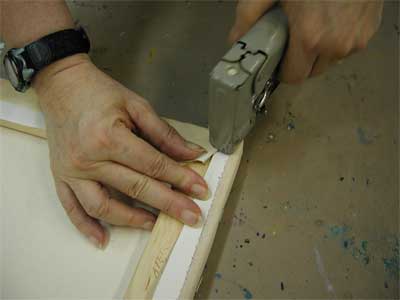
At the corners, make a neat flat tuck and staple in position.

Finally, pull the excess canvas around to the back of the stretcher and staple in position. (Note: you'll find that many of the commercial stretched canvases cut off the excess canvas. I don't recommend this because it makes re-stretching (should you ever need to do that) difficult. The "better" commercially available canvases have begun turning and tacking the excess canvas.


As a last note, many commercial canvases now being marketed are called "gallery style" canvases and don't have any staples on the sides. The canvas is wrapped around the side with no staples and tucked in the stretchers at the back. This is in keeping with the popular push to paint the sides of a canvas and omit the use of a frame entirely. I don't know how to either prepare this kind of stretched canvas or to unstretch it if I wanted to. Being old and conservative (yes, finally I admit it!), I tend to avoid this and pay for frames. A good reasonable source for frames is Graphik Dimensions, whose on-line store is called pictureframes.com. They include a range of prices. While you can buy online, I recommend sending for their catalog by calling 1-800-221-0262. (I am not being paid to advertise them).

Sunday, January 01, 2006

Depth of Field and the Landscape Artist

One aspect of depth perception not covered in my essay on depth The Third Dimension is depth of field.

Depth of field is covered for the photographer in a handy little summary in a booklet called How to Use Your Digital Camera’s Settings by David Schloss as follows:

“If you look at something near you …your eyes automatically adjust themselves so that only the objects you’re looking at are in focus. Switch to looking at a faraway object, and the eye automatically adjusts again, making the distant object instantaneously snap into focus while the nearby things fall into blurriness. Your camera, however, doesn’t have these limitations.

“In both of these cases, all the object within a few inches of the subject are in focus, but outside that range they get progressively blurrier. Our eyes have a shallow depth of field, meaning that the portion (depth) of our view (our field) that is in focus is relatively small…. Your camera doesn’t have this limitation, though, and, depending on the lens, the amount of your photograph that can be in focus at any one time can be vast.”

Now, there’s two points of interest here.

First, because we are so used to looking at the world around us, re-focusing as we shift our vision, we may forget to take into account focal length when painting from the world around us. While “focal point” as a subject is broader than this essay, certainly part of establishing a focal point in a painting depends on being willing to make some part of the canvas sharper (more in focus) than other parts.

Secondly, if — as many artists today do — we take advantage of the camera to record scenes that we can later paint at leisure, we may be forgetting that the camera is indiscriminate when set for wide-angle or point-and-shoot.

I am not one of those proponents of never using photography. It has a lot of benefits as far as I’m concerned, including not having to do battle with bees or weather the weather. But the limits of photography as source material for the visual artist, whatever medium you work in, should be kept in mind. One of those limitations is indiscriminate depth of field.

Wednesday, December 28, 2005

Pricing your art

The following was written as an answer to a fellow artist looking for advice and is posted here for discussion.

Pricing is very personal. Base it on concepts like exchange, what the market will bear, and what you're willing to part with your art for. Take into consideration how long it takes you to paint a painting and what you want or need per hour for your work. Establish your "wholesale price" as the least you want to part with a painting for. The “retail price” should be at least double that depending on what gallery you're in. Some US galleries take 60% and it’s well worth it for a gallery that really sells. My experience is that it's easier to sell your work through a gallery because people assume that the gallery personnel have made important decisions about product viability. People don't usually trust their own intuition. Also, you need to take into account how fast you want to sell. Price lower if you're prolific and you want turnover.

There's another consideration. How long a time do you expect to be in the business of art? I’m 62 now, I've begun thinking about what will happen to my paintings when I die. I mean, I intend to live to at least 85, but who knows. At some point, I will make a list of relatives, buyers, students, and friends and invite them to "have" a painting just to give the paintings a home. (Somewhat like having a cat.) (Those of you reading this who are my friends and students better make sure you let me know when you move!)

In short, pricing art is a personal thing. I would suggest that you browse local galleries and outdoor shows and see if you can get an idea of what the "market price " is. What are people asking? Are they selling?

Small painting by Coulter recently sold on eBayI sell as high as $3400 for large commissioned work. On the other hand, I've recently begun selling small early pieces (16 x 20 and less) on eBay for much less. I decided to try it just to see if there was some kind of market. There was. But browsing through the eBay art market was very discouraging at first because there's so MUCH out there for sale and so little of it sells. I was surprised to find that I have a certain kind of art (sort of impressionist landscape) that apparently fits the market. It is possible that the people who buy go look at my website and bio and decide to buy based on my background and awards. I've sold 6 pieces now and I consider it a viable outlet for older smaller pieces. If you want to see what I offer at any time, just do a search on ebay.com for COULTER. (That’s my signature name.)