I lead an Oil and Acrylic Painting workshop at the Reston Community Center (Reston VA) every Wednesday from 7-10. Here is a picture of several of my students working on an exercise in portraiture. Portraits of children are especially difficult sometimes because there are no definite lines in the face and the features are still very close together. This photo shows three works in progress from the same reference photo.
Sunday, April 25, 2010


Friday, April 23, 2010
Sketch Group
I have found a good life drawing class at the McLean Community Center, McLean Virginia, every Tuesday from 7 - 9:30. It's a good idea for any artist to spend some time each day practicing.
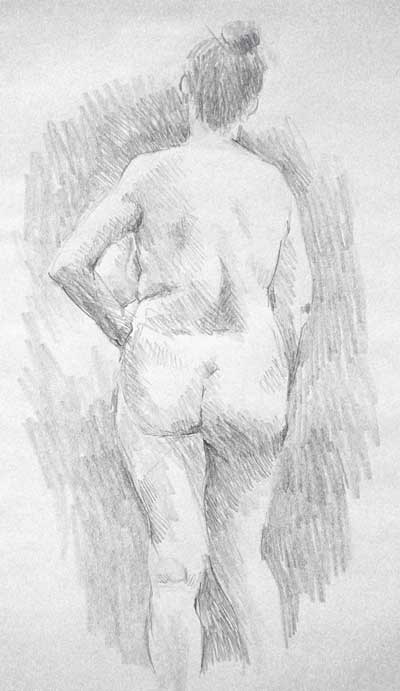
 In the nude sketch shown here, there is nothing particularly interesting from a "final painting" viewpoint. The pose is awkward, the model a bit past her prime. But the lighting — ah, the darks and lights. Objects can be rendered in many ways. We learn to draw, often, using a line as the guide to the edge of an object, but the edge is defined (or lost) by differences in tone or contrast. And the objects flow from one to another, and into the surrounding space. Using shading to define the edges and their relation to other spaces gives you a better appreciation of the composition. Now, that is not to say that line should be abandoned. Not at all. Just another way of looking.
Tuesday, April 20, 2010
Plein Air Painting of Tractor, Riverbend

A couple of weeks ago, I went with two friends down to Riverbend Park where I discovered this lovely little tractor. I roughed it out on site and took a photo. Brought it home and did some finishing touches, edge painted it and put hanging wire on the back. And, voila, it’s ready for the next show. Or for sale! Anyone need a tractor. I will be putting it up on the eBay store.
Wednesday, April 14, 2010
Yellow Sunflowers

I have set the auction starting bid low on this painting for several reasons:
First, setting the starting price lower than the usual sales price makes a game of it.
Secondly, I really do want to find homes for all my "children."
Third, even artists have to eat! haha
I hope you'll go and look. Even if you don't buy, if you put it on your "watch list" it'll stimulate interest. That's a large part of promotion, after all, getting people to pay attention!
Wednesday, April 07, 2010
Great Falls Painting accepted in the April Art League show

Tuesday, April 06, 2010
New exhibit - Coulter paintings
During the month of April, 2010, I am exhibiting two paintings in the League of Reston Artists "founders Show" in the Rose gallery, Reston Community Center, Lake Anne Plaza. "Splash," oil, 20 x 24, $600" and "Vale Schoolhouse," oil, 16 x 20, $400. Both paintings were awarded Honorable Mention.


Tuesday, March 30, 2010
What is Fauve?

In 2008, when I was part of a short-lived group called Max-21, I did an experimental self portrait which I titled "Self-Portrait, Fauve." It's pictured here and you can see a larger version of it on my gallery site. I donated it to the Art League of Alexandria for their annual fund-raiser. I was interested to find that, not only did it sell (not surprising) but also received an Honorable Mention prize. (No money, though, alas!)
Monday, March 29, 2010
What to say?
A visual artist can have writer’s block just like a writer. I’ve certainly experienced this. You can reach a point where you think that there’s nothing more to be said. Maybe, at this point, you should be taking in information. Go to a museum or gallery. Luxuriate in the endless creation that is going on. Come home and pick up a brush or pen or pencil. Don’t worry about perfection. Just practice.

Picasso's Blue period painting Le Gourmet (1901)
Article with video at:
Wednesday, March 24, 2010
Don’t neglect grey
When I was a young artist, still feeling my way around the subject of color and composition, I sometimes wondered why my paintings marched across the surface of the canvas and had little “depth.” It took me a while to discover the importance of the neutrals — probably in part because the art teacher was always harping on not letting your painting get “muddy.”
What’s wrong with mud?
Have you ever noticed that really elegant room designs have mostly subdued colors with one or two color accents used judiciously? That’s not to say that bright, busy compositions don’t have their place (and I remember when, as teenagers, we discovered the use by Mexicans of red, pink, yellow and bright green and blue in fabulous swirling skirts).
But mud has its uses.
A landscape that is all green may be particularly hard to paint. Just too much strong green. But choose well — a field with pale brown stubble, a grey lowering sky, a sparkling river going through it with grey rocks and sandy banks — and you may have something more appealing.

Remember your basic color wheel. The concepts used to mix mud are that the outer ring of the color wheel consists of the pure hues, the rainbow colors. As you mix the three primaries (or any complementary pair) you approach black. Add an little white and you get quantities of mud: greys, browns, ochres, earth reds….
Try it.
The painting pictured above I did years ago. It’s called “Annandale” and was the view from my dining room window. I think it works partly because of the use of neutrals to relieve the strong greens and blues. (Notice the neutrals I used were browns, “warm neutrals” while the blues and greens are cool colors.)
Tuesday, March 23, 2010
Pondering
Ask yourself: what is my purpose as an artist? This is not a serious question. I will allow you to change your answer or come up with several different answers, but do take a moment to think about it. What are you doing as artist? Write it down. Date it. Put it aside where you'll find it later.
I recently met an artist who felt that the all-important thing was finding out what was wanted and producing that. I don’t agree at this point in my career. If I wanted to produce what the public wants, exclusively, I could be a programmer or a short order cook and do it with art.
It’s a little bit like an “almost right item,” an answer that’s close enough to creating what I want that it festers and itches like a hair shirt. This doesn’t mean that I’m right and my friend was wrong. There may be ways that I will develop when I will look back and wonder why I was so stuck on a particular style.
We tend to stick with what we are comfortable, and I have to admit that I’ve never painted a “night scene.” My advice: develop your skill, but try to stretch yourself periodically. And look at what your purpose is as an artist. There may be many answers.
Subscribe to:
Posts (Atom)
