"ART is a word which summarizes THE QUALITY OF COMMUNICATION. "
L. Ron Hubbard

Friday, June 11, 2010

Putting the life into portraits

A neighbor recently gave me some feedback on my portraiture. I like feedback, particularly when it's positive, but negative feedback is also OK if honest.

He said that he was visiting a mutual artist friend, and, as he walked into the living room, he saw a portrait of the man. He immediately thought, "that reminds me of Pam Coulter's style." Not wanting to be offensive, he asked the artist, "Is that a self-portrait?" "No," said my artist friend, "that was done by Pam Coulter."


My neighbor then said, "I just knew it. You put life into the portrait."

How does one put life into the portrait?

Well, I'll tell you, it's a great deal easier when you are painting from life. Particularly when you have a friendly relationship with the sitter. It's more of a challenge when you are using a photo. There you must "grant life" (so to speak) realizing that the photo is a vehicle for getting to the essential person. And this gets a bit into the spiritual universe. Assume that the photo is a dull image of reality. (In fact, the body is a dull image of reality.) The reality is the person himself (or herself) at their very best and brightest. It's the spirit. And that's what you are set on portraying.

In another instance, I recently did a corporate portrait of Mr. Sam Church Jr., past president of the United Mine Workers of America. His widow did not see the portrait until the unveiling, but emailed me and said:

"I wanted you to know that my son, Nathaniel, and I unveiled your portrait at the UMWA headquarters in Triangle this morning. I was overwhelmed. A close friend of Sam's, Nathan Landow, joined us and immediately commented that it was the "Sammy" we remembered from his tenure as UMWA President.

What a surprise. Not a dry eye in the room! Thank you for the remarkable work. I am so proud that the portrait will hang in the new offices for the UMWA and that Sam's legacy is honored."

Wednesday, May 26, 2010

Blending with oils

Some of my students have difficulty with blending. here's a tip. For a smooth transition between two colors, both should be wet. Using a large (size 8 is good) bristle brush that is clean and dry, place 1/2 the brush on one color and 1/2 on the other and slowly stroke back and forth to get a smooth transition. You can blend into a dry color as well this way, but using this technique with wet into wet should provide the most satisfactory blend. If this is not clear enough, visit Bill Martin's explanation, which has pictures.

Saturday, May 15, 2010

Pouting Child

I am very pleased with this painting of a toddler done as a demo of portrait painting for my class. I thought I would share it with all of you. This is painted in oil on canvas, 20 x 16 (a good size for a headshot like this.)

Sunday, May 09, 2010

Aerial Perspective  

dictionary.com gives the following definition:

–noun
a technique of rendering depth or distance in painting by modifying the tone or hue and distinctness of objects perceived as receding from the picture plane, esp. by reducing distinctive local colors and contrasts of light and dark to a uniform light bluish-gray color.
Also called atmospheric perspective.
Where I find a student having difficulty with a landscape painting, it's sometimes due to the use of photographic reference material. "Depth of Field" on the camera is often (if not always) the default setting and many of us use the "point and shoot" technique. The photo prints out "less interesting" than the original scene. 
If you squint your eyes way down and look into the distance, you will often see the effects of atmospheric perspective. The strong contrast and sharp edges in the foreground fade and grey (or blue) to  less distinct colors in the distance. Now, even if you don't particularly see this, you should try it in painting a landscape. For example, in this autumn painting, I emphasized the light blue of the background to "push" the distance into the picture plane. Of course, there are other depth cues in the painting, not least of which is the lane which dwindles to a point at the horizon.

Friday, May 07, 2010

Two paintings on display in the May Reston Community Center show

I have two of my paintings, "Monument Valley" and "Zefferelli's", on display in the annual student-teacher show at the Reston Community Center(RCC) this month.

Pictured here is "Monument Valley". You can see a larger version on my website.
And this is a painting of Zefferelli's restaurant in Herndon.

Wednesday, May 05, 2010

Who knows -- you may be the next picasso

New York Times reports: A painting that Picasso created in a single day in March 1932 became the most expensive work of art ever sold at auction on Tuesday night.

“Christie’s employees took telephone bids during the eight-minute auction for “Nude, Green Leaves and Bust,” a 1932 Picasso.
In an overflowing salesroom at Christie’s, six bidders vied for “Nude, Green Leaves and Bust,” which depicts the artist’s mistress Marie-Thérèse Walter, reclining naked. When the canvas last changed hands, in 1951, it sold for $19,800. But this time, “Nude, Green Leaves and Bust” brought $106.5 million.

Who knows. You could be the next high seller at Christie's. Old Pablo didn't necessarily know he would achieve such fame. He just kept putting it out. Create, create, create!

Sunday, April 25, 2010

Art Class

I lead an Oil and Acrylic Painting workshop at the Reston Community Center (Reston VA) every Wednesday from 7-10. Here is a picture of several of my students working on an exercise in portraiture. Portraits of children are especially difficult sometimes because there are no definite lines in the face and the features are still very close together. This photo shows three works in progress from the same reference photo.

artclass_MirraPortrait

Friday, April 23, 2010

Sketch Group

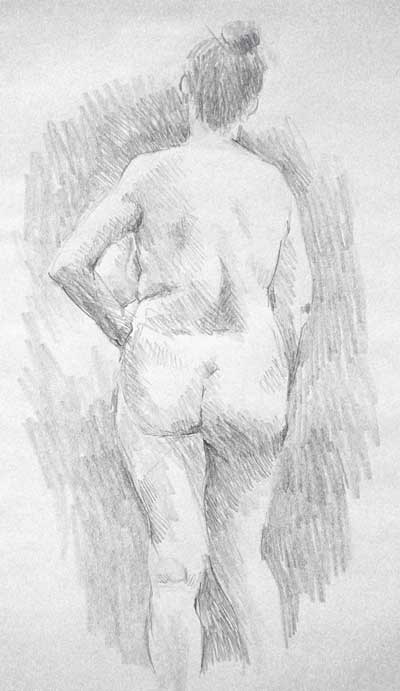
I have found a good life drawing class at the McLean Community Center, McLean Virginia, every Tuesday from 7 - 9:30. It's a good idea for any artist to spend some time each day practicing.
In the nude sketch shown here, there is nothing particularly interesting from a "final painting" viewpoint. The pose is awkward, the model a bit past her prime. But the lighting — ah, the darks and lights. Objects can be rendered in many ways. We learn to draw, often, using a line as the guide to the edge of an object, but the edge is defined (or lost) by differences in tone or contrast. And the objects flow from one to another, and into the surrounding space. Using shading to define the edges and their relation to other spaces gives you a better appreciation of the composition. Now, that is not to say that line should be abandoned. Not at all. Just another way of looking.

Tuesday, April 20, 2010

Plein Air Painting of Tractor, Riverbend

Tractor-at-Riverbend

A couple of weeks ago, I went with two friends down to Riverbend Park where I discovered this lovely little tractor. I roughed it out on site and took a photo. Brought it home and did some finishing touches, edge painted it and put hanging wire on the back. And, voila, it’s ready for the next show. Or for sale! Anyone need a tractor. I will be putting it up on the eBay store.

Wednesday, April 14, 2010

Yellow Sunflowers

I'm promoting this painting "Sunflowers 2010" on eBay auction. It's oil and 16 x 20, side-painted so it can be hung with or without frame, and wired on the back. Visit my store and see other new work.

I have set the auction starting bid low on this painting for several reasons:

First, setting the starting price lower than the usual sales price makes a game of it.

Secondly, I really do want to find homes for all my "children."

Third, even artists have to eat! haha

I hope you'll go and look. Even if you don't buy, if you put it on your "watch list" it'll stimulate interest. That's a large part of promotion, after all, getting people to pay attention!